What does live trading of Nifty, BankNifty and Sensex with option buying actually require from a trader?
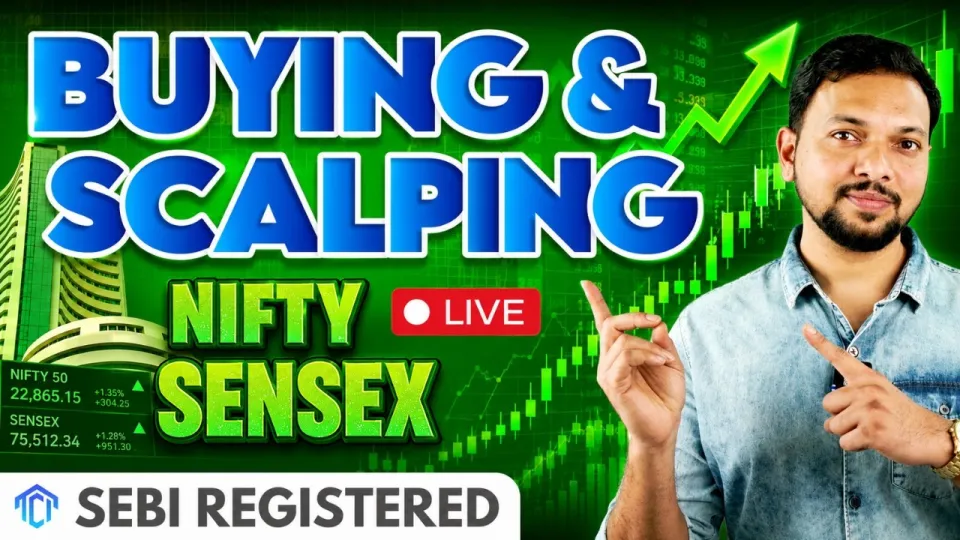
Video: LIVE TRADING Nifty BankNifty and SENSEX | Option Buying | 15 Oct #livetrading
Need articles like this for your video? They help promote it on YouTube and Google — order them in the Telegram bot @sat_sit_bot. It writes articles around your video, embeds the video and publishes them on popular niche websites (no ads). Try it free: 50 articles on us.
· based on the channel TRADING CAFE INDIA
Key takeaways
- Three Indian indices set the session's trading menu: Nifty 50, BankNifty and Sensex, each with its own option chain and volatility profile.
- Option buying caps the loss at the premium paid, but time decay works against a buyer every day the index fails to move.
- In the 15 October live session the channel's audience debated Sensex near 74,300 and strikes around 73,000, where a 400-point premium move was discussed.
- Trading Cafe India is registered with SEBI as a Research Analyst under INH000013767 and states that registration does not guarantee returns.
- Viewer reports from the same stream include both a 13,000 rupee loss and traders still holding losing positions, which is the realistic spread of outcomes.
Live trading of Nifty, BankNifty and Sensex with option buying means picking one index, one direction and one strike before the market opens, then managing a premium that can lose value even when the index barely moves. The practical answer is that option buying on Indian indices is a short-volatility, high-precision game: you need a defined level, a defined strike and a hard limit on what you pay, and the tools and calls used in the 15 October stream are collected behind the Lemonn registration link.
What makes Nifty, BankNifty and Sensex three different trading problems
Each of the three indices trades a different volatility regime, so the same option-buying rule does not transfer cleanly between them. Nifty 50 is the broadest and usually the least explosive, BankNifty concentrates banking heavyweights and routinely moves faster in percentage terms, and Sensex tracks 30 large caps on the BSE with its own strike ladder and liquidity pockets. A buyer of a Nifty weekly option is paying for a modest expected move; a buyer of a BankNifty option is paying for a larger one, and the premium reflects that difference.
The practical consequences are straightforward. Position size measured in premium rupees must be smaller on the more volatile index if you want the same risk per trade. Strike spacing matters more on Sensex, where the chain is thinner than Nifty's and a far strike can be hard to exit at a fair price. And the expiry calendar is not identical across products, so a strategy built on the last-hour gamma of one index does not automatically work on another.
How a live option-buying session is actually structured
A live index option session is built around a handful of decisions made before the first candle, not around reacting to every tick. In the Trading Cafe India stream the format is familiar to Indian retail traders: index levels marked on the chart, a directional bias stated, a strike selected, and the trade narrated as the premium moves. The useful part for a viewer is the order of decisions, which can be copied even if the specific calls are not.
- Mark the previous day's high, low and close on all three indices and note which one is closest to a breakout or breakdown level.
- Decide the direction and the invalidation point first, before looking at any premium.
- Choose the strike whose premium you are willing to lose entirely, not the cheapest one available.
- Set the maximum loss in rupees and the maximum number of re-entries for the day.
- Write down the exit rule for a winning trade as well, because a bought option that goes in your favour and is held too long gives back the gain to time decay.
Why option buying punishes patience more than option selling
An option buyer pays theta every day, so holding a position that does not move is a slow loss rather than a neutral wait. This is the single most misunderstood mechanic in index option buying, and it explains why so many viewers of live trading streams report being stuck in losing positions. If a Nifty or BankNifty option is bought for a directional move and the index consolidates, the premium bleeds even though the chart looks unchanged.
The workaround is not a secret indicator; it is trade design. Buy options when you expect movement within a defined window, size the premium as a cost rather than an investment, and accept that a large share of bought options expire worthless. Sellers collect that decay, buyers pay it, and no amount of conviction changes the arithmetic.
Reading the crowd in a live trading chat
The comments under a live index stream are a useful sample of retail behaviour, and the 15 October session was no exception. Some viewers were convinced Sensex would reach 74,300, others asked about a strike near 73,000 and whether a 400-point premium move was achievable, one reported a 13,000 rupee loss on the day, another admitted still holding a losing position, and several simply asked the host to also cover Nifty.
Those messages map onto four recurring mistakes. First, trading one index while watching another and confusing the two trends. Second, anchoring to a round number because it sounds reachable rather than because the chart supports it. Third, holding a losing bought option in the hope of a reversal that theta makes progressively more expensive. Fourth, taking a call from a stream without a personal stop, which turns a shared idea into an unmanaged position. A live session is educational input, not a position-sizing service.
Risk rules that survive contact with a real session
Risk control in index option buying is arithmetic, and it can be written down before the market opens. A workable framework for a retail account starts with a fixed maximum loss per day, commonly 1 to 2 percent of capital, and treats every premium paid as part of that budget. If a Nifty option costs 2,000 rupees per lot and the daily budget is 6,000 rupees, the trader has three attempts at most, not an unlimited series of re-entries.
Three further rules do most of the work. Never average a losing bought option, because adding to a decaying position multiplies the cost without improving the thesis. Exit on the level, not on the hope, meaning the invalidation point defined before entry is the exit. And stop for the day after the budget is spent, since the sessions where a trader tries to recover a loss are the ones that produce the losses reported in live chats.
What regulation means for anyone following index calls
Trading Cafe India operates as a SEBI-registered Research Analyst under registration number INH000013767, and the channel's own disclaimer states that SEBI registration and NISM certification do not guarantee performance or assure returns. That sentence is the most important line in the description of any market stream, because it separates a regulated research provider from an unregistered tip group.
For a viewer, the practical checks are simple. Verify the registration number on the SEBI website before paying for any service. Treat every index level discussed on a stream as illustration, which the channel explicitly says it is. And remember that securities market investments carry market risk, so any capital committed to option buying should be money whose loss would not change your life.
Useful links
- Lemonn SEBI-registered calls registration
- Nifty and Sensex VIP setups tools
- Free Telegram channel for trades and BTST news
- XM global account with deposit bonus
- CoinSwitch Pro for crypto and gold calls
The takeaway from a live Nifty, BankNifty and Sensex option-buying session
Option buying on Indian indices rewards preparation and punishes improvisation, because the premium is a cost that decays whether or not the chart cooperates. The 15 October session from TRADING CAFE INDIA is a useful case study in how a live desk frames three indices at once, and in how differently viewers act on the same information, from a 13,000 rupee loss to a trader still holding a losing position. Copy the process, not the call: define the level, size the premium as a cost, cap the daily loss and stop when the budget is gone. If you want the regulated research side of that workflow, start with the Lemonn registration link and verify the registration before committing any capital.
Questions & answers
Is option buying on Nifty, BankNifty and Sensex safer than option selling?
Buying caps the maximum loss at the premium paid, which is a real advantage over selling, where losses can exceed the initial margin. The trade-off is time decay: a bought option loses value every day the index fails to move, so the win rate is typically lower and the position must be given less time. Neither approach is safer in absolute terms; they carry different risks.
How much capital do I need to buy one lot of a BankNifty option?
The requirement is the premium multiplied by the lot size, plus broker charges, not the full contract value. Because BankNifty premiums are larger than Nifty premiums for comparable strikes, the same rupee risk buys fewer lots. A common rule is to risk no more than 1 to 2 percent of trading capital on a single bought option.
Can I hold a losing bought option until it recovers?
Holding a losing bought option is expensive because theta keeps reducing the premium while the position waits. If the index has not moved by the invalidation level set before entry, the thesis is wrong and the position should be closed. Traders who hold and hope are the ones reporting large single-day losses in live trading chats.
Does a SEBI registration number guarantee that an index trading service will be profitable?
No. Registration as a Research Analyst, such as Trading Cafe India's INH000013767, confirms regulatory status and compliance, not performance. The channel's own disclaimer states that SEBI registration and NISM certification do not guarantee returns or assure investors of any outcome. Verify the number on the SEBI site and treat all levels discussed on a stream as illustration.
Source: LIVE TRADING Nifty BankNifty and SENSEX | Option Buying | 15 Oct #livetrading · Markdown version